

Charity Case Pt.2: Side Crack and High Action
Instruments- discuss specific features, luthiers, instrument problems & questions
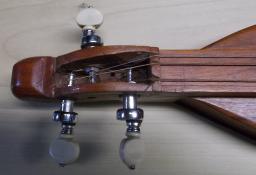
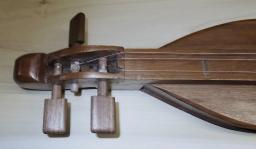
Matt, thanks for adding your "two cents" (man, that cracked me up!). Your comments on nut and bridge material were interesting and your advice may come into play on an intonation nightmare project I've been working on, off and on, for a while. In this case I had to fill in the fixed bridge slot and fashion a floating bridge to remedy a VSL issue and replace the nut with one fabricated with a rounded back-sloping crown to correct for insufficient spacing between the nut and first fret. In both cases the material used was walnut, which is aesthetically pleasing and made a remarkable intonation improvement. Eventually, I may follow your suggestion for use of bone to see if the tonal quality can be improved after some other issues are resolved. I'd love to go into more detail but I don't want to hijack Stewart's thread and this particular instrument really deserves a dedicated post. As best I can, I've tried to stick to action and various intonation issues, pointing out that more than one issue can simultaneously be in play and that the interplay can be confusing enough to drive you up the wall! 
Stewart, I'm glad to see you've made some progress! Now that you're getting the VSL matter nailed down you may wish to evaluate fret spacing. There are at least two ways to do this.
First, you can use your electronic tuner to check for pitch error (in cents) at each fret for as high as you care to go. Record those errors on paper and look for a pattern. If the sharp/flat pattern follows a consistent trend you may be able to address it. If it is random, you may end up having to live with what you've got. At least you'll know where the "sweet spots" are on the fret board. Errors of three cents or under are generally considered tolerable.
Second, try this fret position calculator page: http://www.liutaiomottola.com/formulae/fret.htm#mozTocId169477 - in particular, the one entitled "Calculating Fret Spacing for All Frets". Bear in mind that the fret numbers there refer to a chromatic instrument - like a guitar, so they are really semi-tones. Thus, the first fret on a "standard" dulcimer is at two semi-tones, the second fret at four semi-tones, the third fret at five semi-tones etc. Input the VSL you have settled on then compare the resultant calculated nut to fret measurements to what exists on your fret board. If the discrepancies are random you're more or less "SOL" and will be forced to look for a compromise that considers the "sweet spots" as described above. In the quest for this compromise you can input trial VSLs and look for a better overall agreement of calculated versus actual values then verify with your tuner - or in other words you may get a feel for the VSL that the builder cut the frets slots for.
So much for random pitch errors. Now lets consider a more consistent pattern. With both approaches if the first fret is flat according to the tuner (or short-measure according to the calculator) and the error diminishes as you progress to the seventh fret, the nut to fret intervals are too small (though progressively better as you approach seventh fret). The cause is the nut being too close to the bridge/saddle relative to the fret layout. I had this problem x2 (a courting dulcimer) which was resolved by fabricating a new nuts with rounded crown and built in back slope favoring the peg box side. I don't know if the issue was builder error or shrinking of the fret board over time. As the builder has some notoriety, all my modifications to date have been totally reversible so I can return the instrument to its "as found" state - but that would relegate it to a "wall hanger" due to those serious intonation issues.
For the opposite case, decreasing sharpness, you'd need to move the nut towards the bridge/saddle. You could test this out by fabricating a shim to be placed against the nut on the fret board side (conceptually, sort of a "zero fret"). The required thickness of the shim being determined by trial and error. If you find an adequate correction you could craft a nut that fit the nut groove, but had a projection that duplicated your shim correction. Or, of course, you could re-route the groove to widen it by taking off material from the fret board and use a standard nut profile - but this would not be a reversible measure, so I would not go there unless I was sure there was no collector value to the instrument. Well, I guess I've beat that horse enough for now.
=====
Update: I should have noted that changing the nut to first fret distance also has a corresponding effect on the open string VSL. Therefore, make about half the nut adjustment you think you need, readjust the bridge position and recheck for pitch errors. You just may nail it on the first try. If not rinse and repeat until the sequential pitch errors disappear into the random fret errors (which will most always be present - its just matter of degree).
=====
Randy, I feel your pain, but think of the nickle as an impromptu 0.077" feeler gauge. As you approach that target mark the nickle becomes more stable. And this is more of an adjustment by feel rather than a visual event. As for the feeler gauge for first fret clearance, what I'm looking at is more of a general purpose flat-blade set of 17 gauges. Although this set covers standard spark plug gaps it is not truly a spark plug gauge which would typically have at least one end of the handle equipped with bent wire gauges and, in general, fewer blades. I found my candidate on the O'Reilly Auto Parts page ( https://www.oreillyauto.com/shop/b/tools---equipment-16488/tools-17919/mechanics-tools-16816/feeler-gauges-17312/c5e524a4a742) shown as "Performance Tool Mini Thickness Gauge". I've considered feeler gauges in the past but until my exchange with Ken, I had not taken the time to dope out what the dime as used in the nickle/dime method translated to in terms of actual string to fret crown gap. Knowledge is empowering.
updated by @jim-hedman: 04/01/18 01:48:04AM












 Hope it helps.